You lift your leg.
Click.
You stand up from a chair.
Clunk.
You walk upstairs, stretch, squat, run, or roll over in bed and your hip makes a noise like it’s trying to get your attention.
Sometimes it’s painless and just annoying.
Sometimes it feels tight, sharp, or bloody uncomfortable.
And sometimes it makes you think, “Is something catching in there?”
That snapping feeling is often called snapping hip syndrome. Terrible name, slightly dramatic, but fairly common.
The good news: a snapping hip is not automatically a sign that your hip is damaged.
The more useful question is:
Is it painful, is it changing, and is it stopping you doing normal things?
Let’s break it down.
What is snapping hip?
Snapping hip is when something around the hip moves over a bony point and creates a click, snap, clunk or flicking sensation.
Think of it like a guitar string flicking over the edge of a table.
Most of the time, the “snap” comes from soft tissue moving over bone. That might be a tendon, muscle, or band of connective tissue.
There are three broad types.
1. Outside of the hip: often IT band or glute tendon related
This usually feels like snapping on the outside of the hip.
You might feel it when walking, running, climbing stairs, or moving the leg forwards and backwards.
It can come from the iliotibial band or nearby gluteal tissues moving over the bony point on the side of the hip called the greater trochanter.
In normal language: the tissues on the outside of the hip are flicking over the bony bump.
Sometimes it is painless.
Sometimes it comes with side-of-hip pain, especially lying on that side, walking hills, stairs, or standing on one leg.
This can overlap with gluteal tendinopathy or lateral hip pain, so if it’s painful and persistent, don’t just ignore it.
2. Front of the hip: often hip flexor related
This is probably the classic “snapping hip” people notice.
It often feels like a snap or clunk at the front of the hip or groin, especially when lifting the knee, lowering the leg, getting up from sitting, doing sit-ups, dancing, martial arts, running, or gym work.
This often involves the iliopsoas tendon, one of your main hip flexor structures, moving over the front of the hip.
Again, it can be painless.
But if it becomes sore, tight, or irritating, it may mean the hip flexor is doing more work than it currently tolerates.
This is common in people who sit a lot, train inconsistently, or suddenly increase running, gym work, yoga, Pilates, dance, or sport.
The hip flexor gets blamed for being “tight,” but the real issue may be load, control, fatigue, or poor hip and trunk strength.
3. Deep inside the hip: sometimes joint-related
This is the one to take more seriously.
If the click feels deep inside the hip and comes with pain, locking, catching, giving way, or a sense that the joint is stuck, it may not just be a tendon flicking over bone.
It could involve structures inside the hip joint, such as the labrum or cartilage.
That doesn’t mean panic.
But it does mean it’s worth getting assessed rather than forcing stretches and hoping for the best.
A noisy hip is often harmless.
A painful, catching, locking hip deserves more attention.
Why does snapping hip happen?
There is rarely one single cause.
Common contributors include:
- sudden increases in activity
- lots of sitting followed by intense exercise
- reduced hip strength or control
- stiff lower back or pelvis
- poor recovery
- repetitive hip flexion, like cycling, running, kicking or squatting
- old injuries
- naturally mobile hips
- training too hard after doing not much for a while
Let’s be honest: most people don’t gradually prepare their hips for activity.
They sit all week, feel guilty, then suddenly do a long walk, gym class, DIY session, run, hike, game of football, or martial arts session.
Then the hip starts clicking like a sarcastic metronome.
That is often a load-management problem, not a disaster.
3 Practical Tips for Snapping Hip
Tip 1: Stop obsessively clicking it
This is the first mistake.
People find the movement that makes the hip snap, then repeat it twenty times a day to “check if it’s still there.”
Yes. It is still there.
And now you’ve irritated it.
If a movement repeatedly creates snapping and discomfort, stop deliberately provoking it.
You are not gathering useful data. You are poking the bear.
Instead, track the useful information:
- where do you feel the snap?
- is it painful or just noisy?
- does it happen at the front, side, or deep inside?
- is it worse after sitting?
- is it worse after running, gym, stairs or hills?
- is there catching, locking or giving way?
That information helps you work out whether it’s likely tendon-related, side-of-hip related, or something deeper.
Easy rule:
Noisy but painless is usually less concerning. Painful, catching or locking deserves assessment.
Tip 2: Calm the irritated tissues before trying to stretch everything
When the hip snaps, the usual instinct is to stretch the hip flexors.
Sometimes that helps.
Often it doesn’t.
Especially if the tendon is irritated, repeatedly yanking it into big stretches may just keep it sensitive.
For a week or two, try reducing the movements that wind it up:
- repeated high knee lifts
- deep lunges
- aggressive hip flexor stretches
- lots of sit-ups
- hill running
- heavy squats or deadlifts if they aggravate it
- sitting for long periods without breaks
Notice I said reduce, not ban forever.
You’re not fragile. You’re just trying to stop repeatedly irritating the same area.
Use gentle movement instead:
- short walks
- easy hip circles
- small-range lunges
- gentle bridges
- light cycling if tolerated
- regular standing breaks from sitting
You want the hip to feel safer and less reactive before asking it for more.
Tip 3: Build hip control and strength
This is the bit that actually moves the needle.
If the hip keeps snapping because the area is overloaded or poorly controlled, stretching alone is unlikely to fix it.
You need capacity.
Start with simple strength and control work:
Glute bridges
- slow and controlled
- 8–12 reps
- focus on the glutes, not cramping the hamstrings
Sit-to-stands
- from a chair
- control the lowering
- 8–12 reps
Step-ups
- low step to start
- knee tracking comfortably
- 6–10 each side
Side-lying hip abduction or standing band work
- gentle, controlled
- useful for side-of-hip strength
Dead bug or marching drills
- helps hip flexors work with the trunk rather than doing everything alone
The goal is not to smash yourself.
The goal is to teach the hip to move with control, strength and confidence.
Use the 24-hour rule:
If exercises make the hip mildly aware but no worse the next day, you are probably in the right zone.
If pain ramps up and stays worse, scale it down.
When should you get snapping hip assessed?
Get it checked if:
- the snapping is painful
- it is getting more frequent or more intense
- there is catching, locking or giving way
- pain feels deep in the groin or inside the joint
- you are limping
- you have night pain that is not position-related
- it is stopping you exercising, walking, working or sleeping
- symptoms are not improving after a sensible period of modification
Seek urgent medical help if there has been significant trauma, you cannot weight-bear, there is obvious deformity, or you have fever, unexplained weight loss, or severe worsening pain.
Most snapping hips are not emergencies.
But persistent painful snapping is not something to ignore for months while doing random stretches from the internet.
How osteopathy can help
The useful question is not simply:
“Why does my hip click?”
The useful question is:
What structure is likely causing it, why has it become irritated, and what does it need next?
At Thrive Body Clinic, based in Worthing Leisure Centre, an assessment can help work out whether the snapping is more likely to be:
- hip flexor related
- IT band or gluteal tendon related
- linked to low back or pelvic mechanics
- related to hip joint irritation
- part of a wider strength or load-management issue
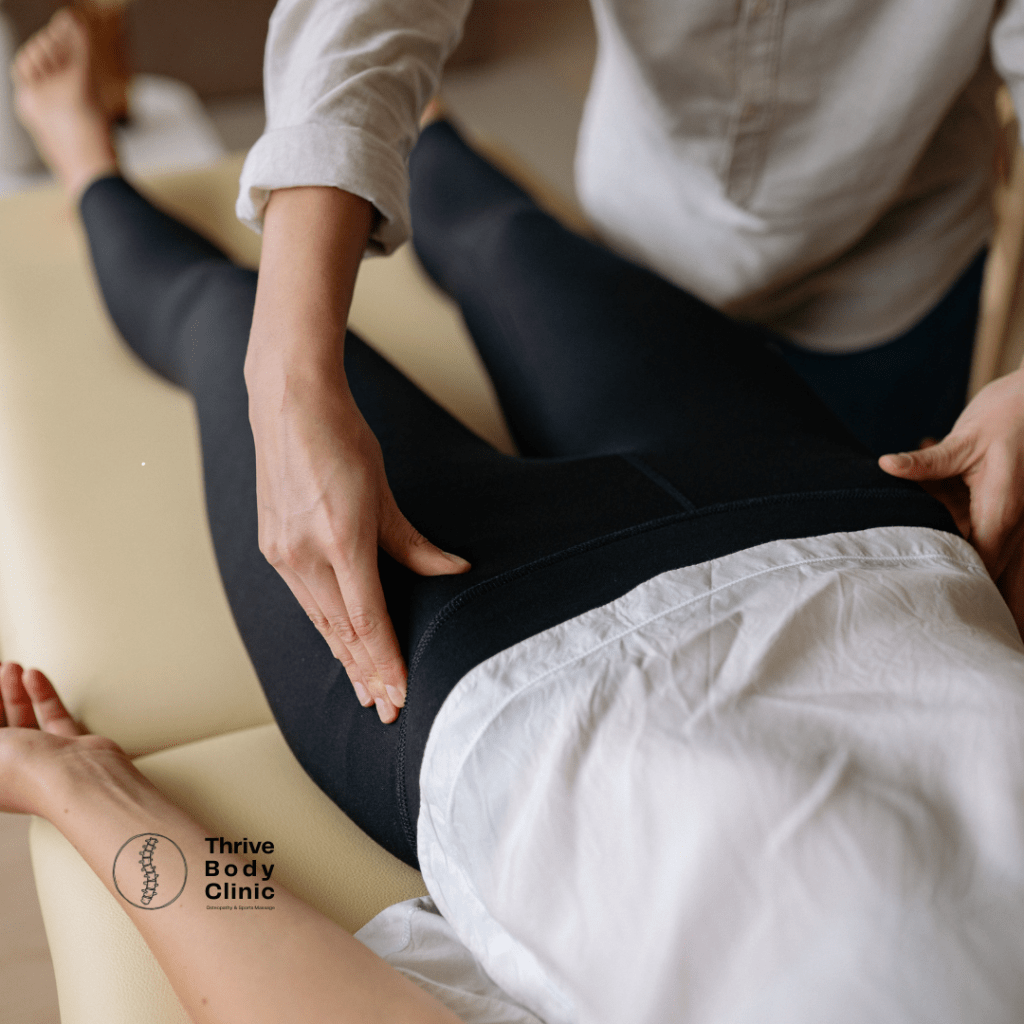
Hands-on treatment may help reduce protective muscle tension, improve movement through the hip, pelvis and lower back, and calm irritated tissues.
But the key part is the plan afterwards.
What should you temporarily reduce?
What should you keep doing?
What needs strengthening?
How do you return to running, gym, walking, sport or normal life without the hip kicking off again?
That is where proper assessment beats guessing.
Final thought
A snapping hip is not automatically a problem.
Some hips click, clunk and pop for years without causing any harm.
But if the snapping is painful, worsening, deep, catching, locking, or stopping you doing things, it deserves attention.
So remember:
Noisy and painless? Usually not a drama.
Painful and repeatable? Modify and rebuild.
Deep catching or locking? Get it assessed.
If your hip keeps snapping and you are not sure what is driving it, book an appointment at Thrive Body Clinic, based in Worthing Leisure Centre.
We will work out what is going on and give you a clear, realistic plan to get moving comfortably again.


Leave a comment