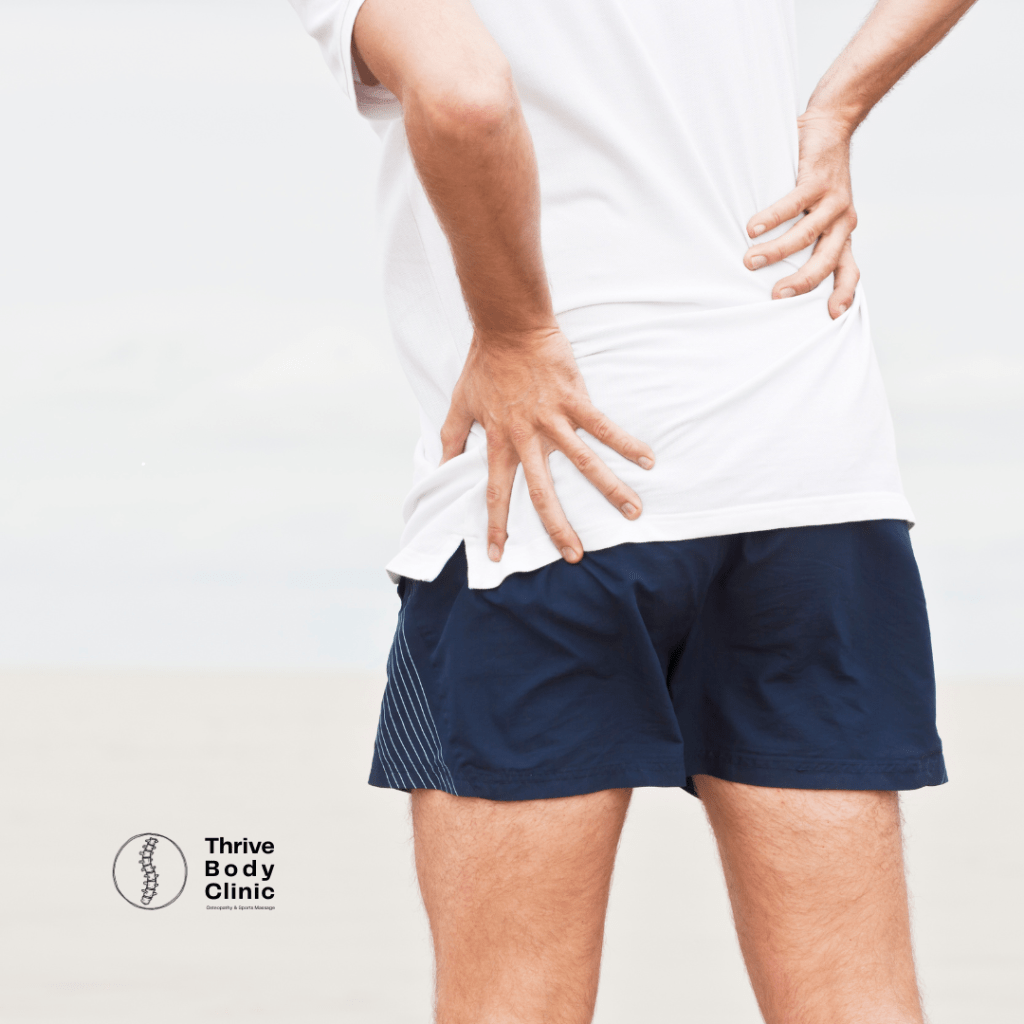
If you’ve got low back pain and you keep pointing to your hip, your glutes, or the side of your pelvis saying, “It’s kind of… here,” you’re not alone.
Hips and low back pain are basically best mates. When one gets grumpy, the other often joins in. And then you end up in that annoying loop where you don’t know what you’ve actually injured, so you either do nothing… or you do a random YouTube stretch routine and hope for the best.
Let’s be honest: that approach is a bit of a lottery.
Here’s a clear way to understand hip vs low back pain, why it often overlaps, and 3 practical tips that genuinely help busy people who don’t have time for rehab.
Why hips and low back pain overlap so much
Your low back, pelvis, and hips are one unit. They share:
- muscles (glutes, hip flexors, deep rotators, hamstrings)
- nerves
- load from walking, lifting, running, stairs, sitting, driving
Analogy: imagine a set of gears. If one gear is stiff or weak, the others have to work harder. Eventually something complains — and your brain just labels it as “back” or “hip” pain even if the driver is somewhere in the middle.
This is why:
- a stiff hip can overload the low back
- a sensitised low back can make the hip feel “tight”
- a weak glute can make everything feel unstable
Common patterns I see (and why they matter)
1) Low back pain referring into the glutes or side of the hip
Often feels achy, tight, sometimes sharp with bending or getting up from sitting. Can be worse after long sitting or first thing in the morning.
2) True hip joint pain
Often feels deep in the groin or front of the hip. Can be sore putting socks on, getting in/out of a car, walking uphill, or pivoting.
3) Lateral hip pain (side of the hip)
Often gluteal tendinopathy/bursitis-type irritation. Worse lying on that side, climbing stairs, standing on one leg, or long walks.
4) Nerve-type symptoms
Pain, tingling or numbness down the leg. That changes the game — you treat it differently than a muscle strain.
The point isn’t to diagnose yourself perfectly. It’s to stop doing the wrong thing for months.
The usual causes
For busy mid-life adults, hips and low back pain often come from:
- lots of sitting + stiff hips + weak glutes
- sudden spikes in activity (“I’ll do a long walk to be healthy” after weeks of nothing)
- lifting poorly when tired (kids, shopping, DIY, gardening)
- stress + poor sleep increasing pain sensitivity
- old niggles that never got properly rebuilt, just “managed”
And yes, sometimes it’s arthritis, disc irritation, stenosis, or a specific hip impingement pattern — but even then, the solution is rarely “rest forever.”
Red flags: when you should seek help quickly
Don’t mess about if you have:
- Bowel/bladder changes, numbness in the saddle area, or rapidly worsening leg weakness → urgent assessment (A&E).
- Unexplained weight loss, fever, night sweats, or constant severe night pain → GP urgent review.
- Major trauma (fall, car crash) or you can’t weight-bear properly → urgent assessment.
Also: if you’ve got leg pain with significant numbness/tingling, or your symptoms are worsening week to week, get it checked.
3 practical tips
Tip 1: Stop chasing “perfect posture” — start changing position often
Most hips and low back pain doesn’t come from one “bad posture.” It comes from too long in one posture.
If you sit for work, drive a lot, or spend evenings slumped because you’re shattered, your system gets stiff and sensitive.
Do this:
- change position every 20–30 minutes (stand, walk, stretch lightly)
- 2–5 minutes is enough — you’re just resetting the system
- if sitting triggers pain, add lumbar support (rolled towel) and keep feet supported
Easy rule:
“Your best posture is your next posture.”
Tip 2: Give your hips and low back some daily movement (5 minutes, not an hour)
You don’t need a full yoga class. You need consistency.
Pick two of these once or twice a day:
- Hip flexor rock-back (half-kneeling, gentle)
- Glute bridge x 8–12 reps (slow, controlled)
- Knees-to-chest or child’s pose 30–60 seconds (if it feels good)
- Thoracic rotation (open book) x 6–8 each side
- Short walk after meals (10 minutes)
If it makes you feel looser and calmer afterwards, keep it. If it flares you for 24 hours, scale it down.
Tip 3: Build strength where it matters: glutes + hips + basic hinge
Stretching alone won’t fix recurring hips and low back pain if the area can’t tolerate load.
Most people need:
- stronger glutes
- better control of hip hinge patterns (bending/lifting)
- better single-leg tolerance (stairs, walking, getting out of a car)
Start simple:
- Sit-to-stands (from a chair) x 8–12
- Step-ups x 6–10 each side
- Glute bridges x 8–12
- Hip hinge practice with a broomstick or light weight
Two to three short strength sessions per week beats one heroic session that overdoes it.
How osteopathy helps
Osteopathy isn’t about “putting your hip back in” or “realigning the pelvis.” That’s not how bodies work.
At Thrive Body Clinic (Worthing), I can:
- work out whether the driver is more hip joint, glute/tendon, low back, or nerve-related
- calm the area down with hands-on treatment (muscles, joints, ribcage, thoracic spine as needed)
- improve movement where you’re stiff and reduce protective tone
- give you a realistic plan you’ll actually do — not 17 exercises you forget
- tell you when GP input or imaging is sensible
The goal is confidence: less fear, better movement, and a body that tolerates normal life again.


Leave a Reply