If you’ve had a migraine, you’ll already know this: it’s not a normal headache.
It’s not “a bit of stress.” It’s not something you can just push through with a coffee and a paracetamol.
A migraine can wipe out a day. Sometimes two. It can leave you feeling sick, light-sensitive, foggy, and weirdly anxious about when the next one will hit. And because it’s invisible, people often underestimate it — including the person having it.
Let’s cut through the noise online and explain migraines properly: what they are, why they happen, what triggers them, and where osteopathy can fit in (without pretending we can “cure” them).
What is a migraine?
A migraine is a neurological event — basically your nervous system going into overdrive — not just a sore head.
Common migraine symptoms include:
- Moderate to severe headache (often one-sided, but not always)
- Throbbing or pulsing pain
- Nausea and/or vomiting
- Sensitivity to light, sound, or smell
- Visual changes (aura) — flashing lights, zig-zag lines, blind spots
- Dizziness, brain fog, fatigue
- Neck pain and shoulder tension (very common)
Some people get warning signs hours before: yawning, food cravings, mood changes, stiffness, or feeling “off.” That’s your brain telling you it’s gearing up.
What’s happening in the body (simple version)
Migraine is complex, but here’s the useful model:
Think of your nervous system like a smoke alarm.
A normal headache is the alarm going off because there’s a bit of smoke (tension, dehydration, poor sleep).
A migraine is the alarm being overly sensitive — it can go off because you made toast.
In migraine, your brain becomes more reactive to triggers. This involves changes in nerve signalling, blood vessel behaviour, inflammation around nerves, and how the brain processes pain. The trigeminal nerve (a major facial nerve) is often involved.
Here’s the key point:
Migraine isn’t weakness. It’s sensitivity.
And sensitive systems need better management, not more brute force.
Triggers: why migraines “sneak up”
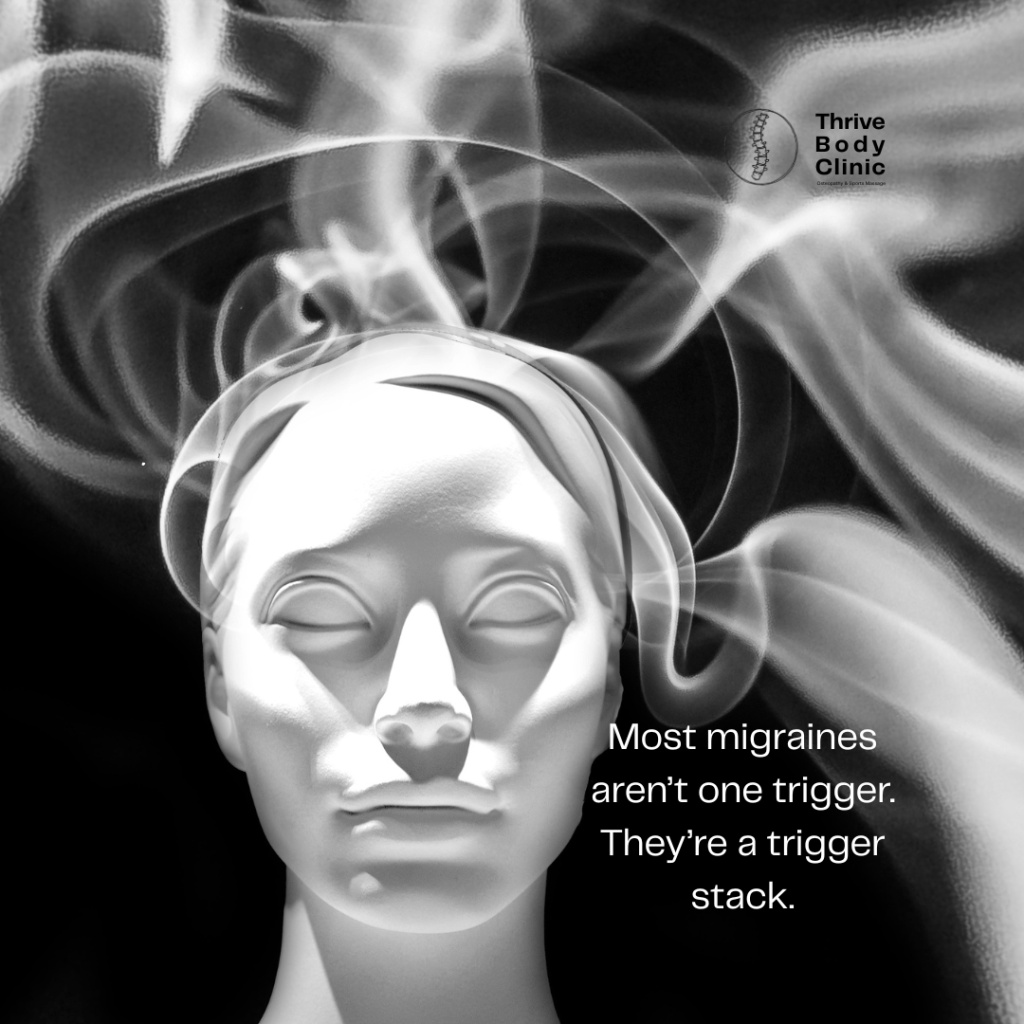
Most migraines aren’t caused by one thing — they’re caused by a “trigger stack.”
You’re fine… until you’re not.
Common triggers include:
- Poor sleep (or even oversleeping)
- Stress (and the “come-down” after stress)
- Dehydration
- Skipped meals / blood sugar dips
- Alcohol (especially wine)
- Hormonal changes (peri-menopause is a big one)
- Caffeine swings
- Bright screens / glare
- Neck and jaw tension
- Certain foods (varies massively person to person)
That’s why someone can say, “I did the same thing last week and I was fine.”
Yes — because last week the stack wasn’t as high.
What people commonly get wrong
“It’s just a headache — I’ll ignore it.”
Ignoring early signs is one of the fastest ways to turn a manageable migraine into a full knockout.
“If I fix my posture I won’t get migraines.”
Posture can be part of the picture, but migraine is neurological. We can’t posture-correct it away.
“Neck pain means it’s not a migraine.”
Neck pain is extremely common with migraines. For many people it’s part of the prodrome (early phase), not the cause.
“I just need stronger painkillers.”
Medication can help, but it’s not the whole plan. Migraines respond best to a combined approach: trigger management + nervous system regulation + physical factors.
Where osteopathy can help (realistically)
Osteopathy doesn’t “cure” migraine. But it can help with common contributors that make migraines more likely and more intense:
1) Neck and upper back mechanics
Stiff joints and overloaded muscles in the upper neck and upper back can amplify headaches and make recovery slower.
2) Ribcage and breathing
Shallow breathing keeps the nervous system in a higher-alert state. Improving rib movement and breathing patterns helps calm the system.
3) Jaw and facial tension
Clenching and grinding are migraine accelerators for many people — especially during stress.
4) Nervous system down-regulation
Hands-on treatment + simple breathing strategies can reduce the “wired” feeling and help your body shift out of fight-or-flight.
Many migraine sufferers report fewer “background headaches,” less neck tension, and a better ability to spot and manage early warning signs.
What you can do outside clinic
- Hydrate like an adult: consistent water intake beats chugging when it’s too late.
- Don’t skip meals: keep blood sugar steady.
- Protect sleep: regular bedtime/wake time matters more than perfect hours.
- Reduce screen strain: breaks, brightness, posture variety.
- Track the stack: quick notes on sleep/stress/food/hormones can reveal patterns.
- Early action: when warning signs start, don’t wait — calm the system early.
Red flags: when you need urgent medical help
See urgent medical care if you have:
- A sudden “worst headache of your life”
- New neurological symptoms (weakness, slurred speech, confusion)
- A new migraine pattern after 50
- Headache with fever, stiff neck, or rash
- Headache after head injury
- Visual loss that doesn’t resolve
Final thoughts: you’re not broken — you’re sensitive
Migraines are brutal, but they’re manageable. The goal is not “tough it out.” The goal is to understand your triggers, reduce the load on your nervous system, and build a plan that makes you feel more in control.
If migraines are affecting your work, sleep, training, or family life, book in. We’ll look at the physical contributors and help you build a realistic strategy alongside your GP care.
 Thrive Body Clinic Osteopathy & Sports Massage
Leave a comment