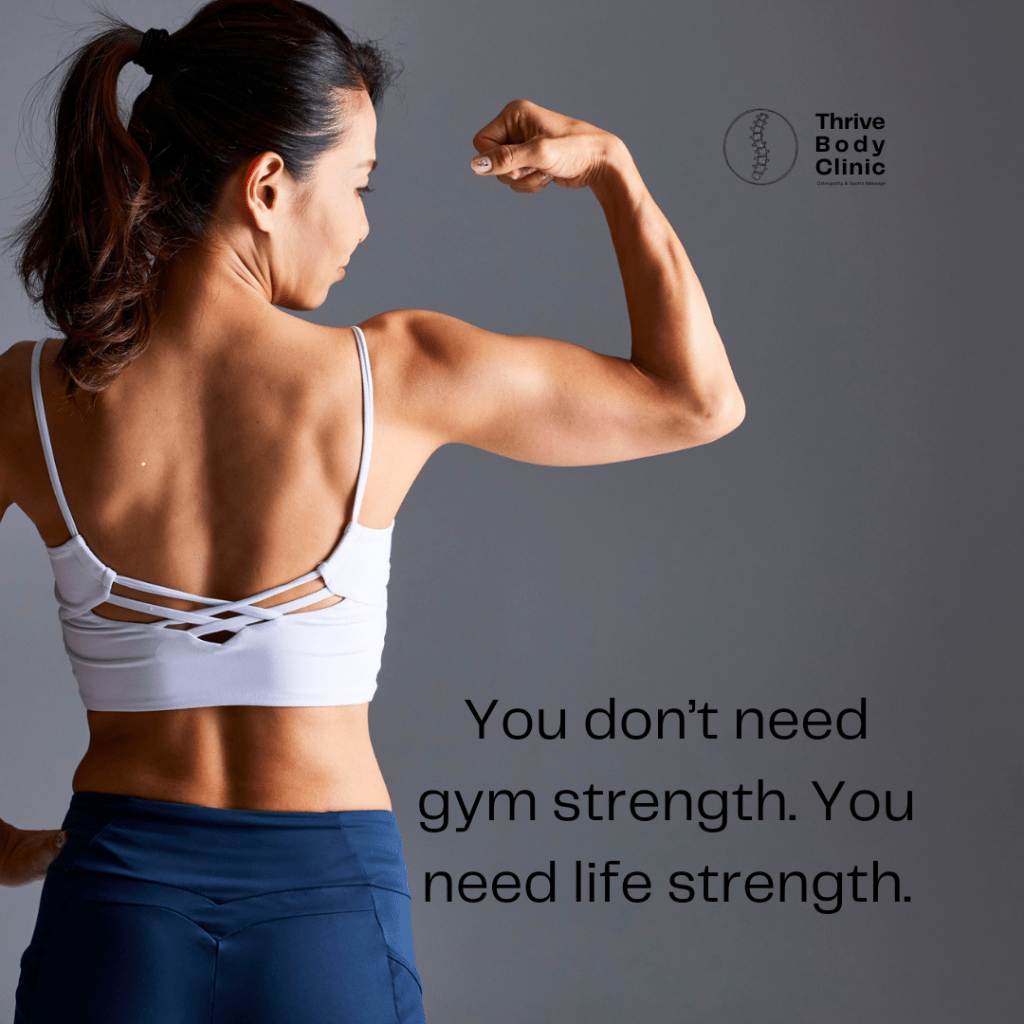
Strong for real life, not for Instagram PRs.
Let’s be honest – most people over 40 don’t care what they can deadlift on Instagram.
What they do care about is:
- Can I carry the shopping without my back kicking off?
- Can I get off the floor without feeling ridiculous?
- Can I move furniture, lift the dog, play with the kids or grandkids… without paying for it for three days after?
That’s real-life strength. And it matters more than any personal best in the gym.
The brutal truth is this:
From around 30 onwards, if you’re not doing something to maintain muscle and strength, your body quietly starts giving some of it away. Slowly at first, then faster. That’s why stairs feel harder, getting off the sofa needs momentum, and everyday jobs feel heavier than they used to.
You’re not “getting old and useless” – but your body is responding to how you use it.
The good news? You don’t need to live in a gym or become a powerlifter to turn this around. You just need to train in a way that supports everyday life.
Here are 3 practical tips to help you stay strong enough for real life after 40.
Tip 1: Think in “Real-Life Strength Tests”, Not Gym Numbers
Forget the barbell numbers for a moment.
Ask yourself these questions instead:
- Can I get up and down from the floor without using my hands?
- Can I carry two heavy shopping bags from the car without stopping?
- Can I climb a flight of stairs without feeling like I’ve done a workout?
- Can I lift something awkward – like a suitcase – without panicking about my back?
If the answer to one or more is “not really” or “only if I’m careful”, that’s your starting point.
Real-life strength is built around a few basic movements:
- Squat – getting on/off chairs, toilets, low sofas, the floor.
- Hinge – bending to pick things up without folding your spine in half.
- Push – pushing doors, trolleys, bodyweight off the floor.
- Pull – opening heavy doors, rowing, using your arms properly.
- Carry – shopping, kids, boxes, life.
You don’t need a fancy programme – you need to deliberately practise these patterns a couple of times a week.
A simple “real-life” mini-checklist:
- Sit-to-stand from a normal chair 10–15 times without using your hands.
- Hold a light-ish weight in each hand and walk around the room.
- Push yourself away from a wall in a “wall press-up” 10–15 times.
If that already feels tough – you’ve got a clear signal. Do more of it, not less.
Tip 2: Do Small, Repeatable Strength Work – Not Hero Workouts
Most mid-life adults mess this up by going all or nothing.
They either:
- Talk about getting strong “at some point” and never start.
- Or smash one huge session, break themselves, then don’t do anything for three weeks.
Neither builds useful strength.
What works?
Small, boring, repeatable strength work.
2–3 times a week, 10–20 minutes, focused on the basics:
- Squats to a chair
Stand in front of a sturdy chair. Sit down with control, stand up again. Start with 2 sets of 8–10 reps. - Hip hinges
Hands on hips, soften knees slightly, push hips back as if you’re closing a drawer with your bum, then stand tall. Once you’ve got the pattern, you can hold a weight. - Wall or kitchen-counter push-ups
Hands on the wall or counter, step your feet back, lower your chest towards your hands, push away. 2 sets of 8–12. - Loaded carry
Two shopping bags or dumbbells. Stand tall, walk around the room or down the garden and back. Don’t overthink it.
You’re aiming to feel:
- Muscles working
- Breathing a little heavier
- But not wiped out
If you finish a session and dread doing it again – you’ve done too much. Dial it back and make it sustainable.
Strength is built by consistency over months, not by one glorious gym session you brag about and never repeat.
Tip 3: Protect Your “Strength Capacity” with Recovery and Common Sense
Being strong enough for everyday life isn’t just about what you do in a workout – it’s about how your body copes with the week as a whole.
If your stress is high, your sleep is rubbish, and you’re already running on fumes, then smashing yourself in the gym is more likely to tip you over the edge than turn you into an everyday athlete.
So, a few rules:
- Don’t chase soreness.
Being crippled after every session is not a badge of honour. It just means you’ve made it harder to be active the next day. - Prioritise sleep when you can.
Not perfect, but better. Your body repairs when you rest. Strength gains are made outside the session. - Respect pain – but don’t let it own you.
If something hurts sharply or feels wrong, back off that move. But don’t abandon all activity. Often we just need to adjust load, angle, or range.
This is also where osteopathy fits in nicely.
At Thrive Body Clinic, I’m not just interested in “treat and send you away.” I want you to:
- Move better
- Load better
- Recover better
If something keeps flaring when you try to get stronger, that’s a signal to get it properly assessed. We can often free up joints, calm irritated tissues, and tweak your plan so you can keep going.
Final Thoughts: Strength as Insurance for Real Life
You don’t have to be “gym strong”.
You do need to be life strong.
Strong enough to:
- Pick things up without panicking about your back
- Get off the floor without drama
- Keep up with kids, grandkids, dogs, stairs, and holiday luggage
That kind of strength doesn’t happen by accident – especially after 40.
But it also doesn’t require perfection.
- Know what “strong enough” looks like in real life.
- Do small, consistent strength work focused on the basics.
- Look after recovery so your body can adapt instead of just surviving.
Your future self – 5, 10, 20 years from now – will be very glad you started.
 Thrive Body Clinic Osteopathy & Sports Massage
Leave a comment