If you’ve had a cough for months, get short of breath on hills you used to walk easily, or feel like you can’t “get a full breath in”… it’s not just being unfit.
For many people, it’s chronic bronchitis, often as part of COPD (Chronic Obstructive Pulmonary Disease). And while the lungs are the headline, the rest of your body often ends up carrying the knock-on effects — especially your neck, ribs, upper back, and shoulders.
This blog is here to do two things:
- explain what chronic bronchitis/COPD actually is in plain English, and
- show how osteopathy can support you alongside your NHS care — to help you move, breathe and cope better day-to-day.
What Chronic Bronchitis and COPD Actually Mean
Chronic bronchitis means inflammation in the airways (bronchial tubes) that leads to a persistent cough and mucus production. Clinically, it’s often defined as a productive cough for at least 3 months a year, for 2 years.
COPD is a broader term that includes chronic bronchitis and emphysema. The core issue in COPD is that airflow in and out of the lungs becomes restricted — not because you’re weak, but because the airways are inflamed, narrowed, or less elastic.
Think of it like breathing through a slightly squashed straw. You can still breathe — but it’s harder work, and you fatigue faster.
Common Symptoms People Ignore for Too Long
COPD doesn’t usually arrive with a bang. It creeps in.
Common signs include:
- A long-standing cough (often worse in the morning)
- Mucus/phlegm that won’t shift
- Wheeze or chest tightness
- Shortness of breath with activity
- Getting tired more easily
- More frequent chest infections
- Feeling like you can’t take a deep breath
A lot of people normalise these symptoms for years — especially if they’ve smoked in the past, work in dusty environments, or have had repeated infections.
But ignoring it doesn’t make it go away. Getting the right support early matters.
What’s Actually Happening in the Body
When breathing becomes harder, your body adapts.
If you can’t move air easily using your diaphragm and ribcage, your body recruits “helper muscles” — mainly in the neck, shoulders, and upper chest.
These include muscles like the scalenes and upper traps. Great in short bursts. Not great when they’re doing your breathing all day.
That’s why COPD often comes with:
- Neck and shoulder tension
- Upper back stiffness
- Rib restriction
- Headaches (from constant muscle tension)
- Postural changes (rounded shoulders, “chest breathing” pattern)
- Fatigue and reduced movement confidence
This matters because when the ribcage and upper spine stiffen, breathing can feel even tighter — not because the lungs suddenly got worse, but because the mechanics around the lungs are restricted.
What People Commonly Get Wrong
Let’s clear a few things up:
❌ “If I’m breathless I should avoid exercise.”
No. Avoiding activity causes deconditioning, which makes breathlessness worse. The right kind of movement is one of the best tools you have.
❌ “Osteopathy can treat COPD.”
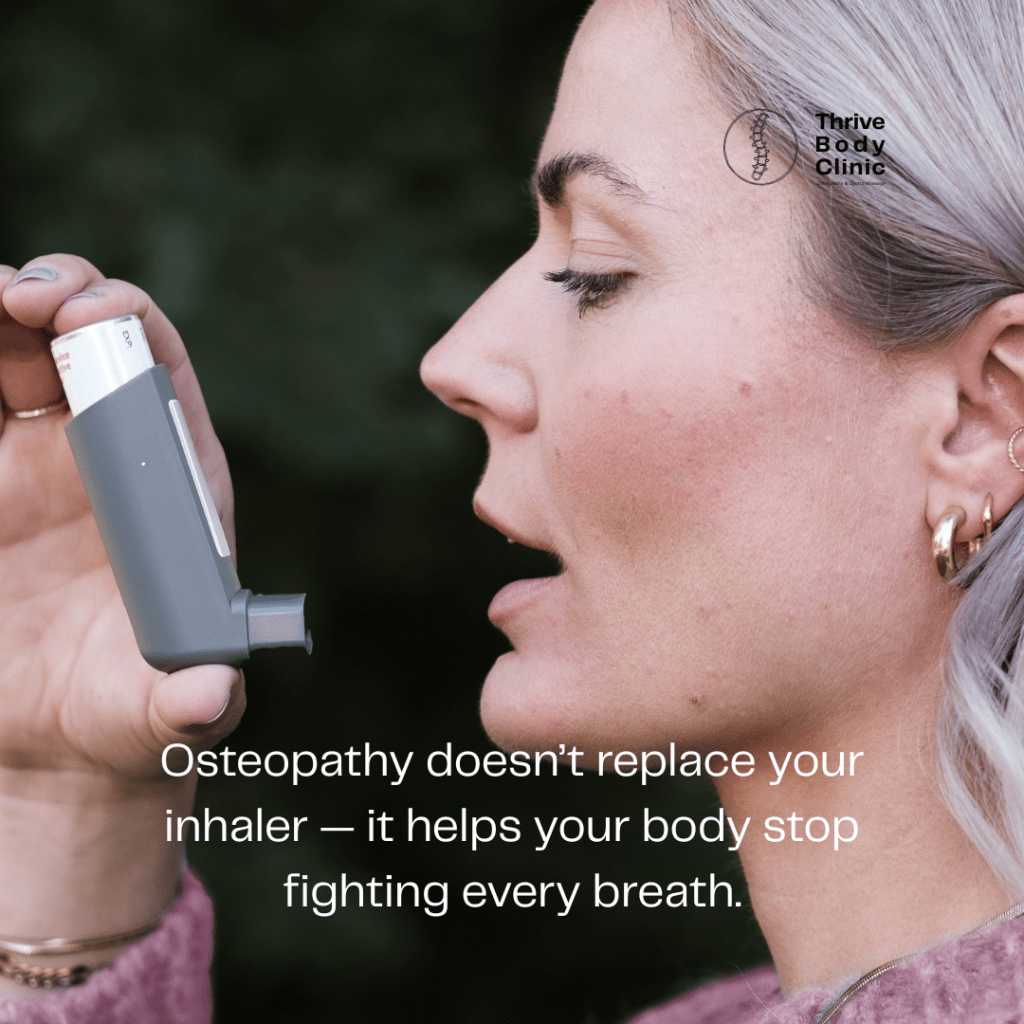
Also no. Osteopathy doesn’t replace inhalers, pulmonary rehab, or your GP/respiratory team. It supports your body around the condition.
❌ “It’s just my lungs.”
It’s lungs and mechanics and nervous system. You’re a whole human, not a set of organs.
How Osteopathy Can Help (Realistically)
At Thrive Body Clinic, osteopathic care for COPD is about reducing strain, improving mechanics, and helping you function better, not “curing” the condition.
Here’s what we often focus on:
✅ Ribcage mobility
If ribs are stiff, breathing feels smaller. Gentle work can help restore movement so the lungs have more room to expand.
✅ Upper back and thoracic spine
A rigid upper back equals rigid breathing. Improving thoracic movement can reduce the “stuck chest” feeling.
✅ Neck and shoulder tension
If your breathing is living in your neck, those muscles will ache. Hands-on treatment can reduce overload and headaches.
✅ Breathing pattern coaching
Not complicated breathwork — just practical guidance: slower breathing, better rib expansion, less “panic breathing.”
✅ Nervous system support
Breathlessness can trigger anxiety, and anxiety worsens breathlessness. Calming the system can reduce the spiral.
Many patients report:
- Feeling “looser” through the chest
- Less neck/shoulder pain
- Easier breathing mechanics
- Better comfort with activity
- More confidence moving again
What You Can Do at Home
Small daily habits matter more than big one-off efforts:
1) Move every day
Walking is brilliant. Short and frequent beats long and exhausting. Aim for consistency.
2) Try a rib-opening breath
Hands around the lower ribs. Breathe into the sides of your ribcage, not just the upper chest.
Even 2 minutes helps.
3) Pace your effort
Stop trying to “push through.” COPD responds better to planned pacing than heroic bursts.
4) Stay on top of medical care
Inhalers, reviews, pulmonary rehab, vaccinations — these are foundational.
5) Posture breaks
If you sit a lot, do 30 seconds of standing tall, shoulder rolls, and a few slow breaths every hour.
Final Thoughts: You’re Not Weak — You’re Adapting
Chronic bronchitis and COPD can be exhausting, frustrating, and at times scary. But you’re not helpless.
With good medical care, smart movement, and hands-on support to reduce the strain your body carries, many people feel noticeably more comfortable and confident.
If your breathing is affecting your energy, posture, or pain levels, you don’t have to just “get on with it.”
👉 Book an appointment at Thrive Body Clinic and we’ll support your body alongside your NHS care — so breathing feels less like hard work.
 Thrive Body Clinic Osteopathy & Sports Massage
Leave a comment