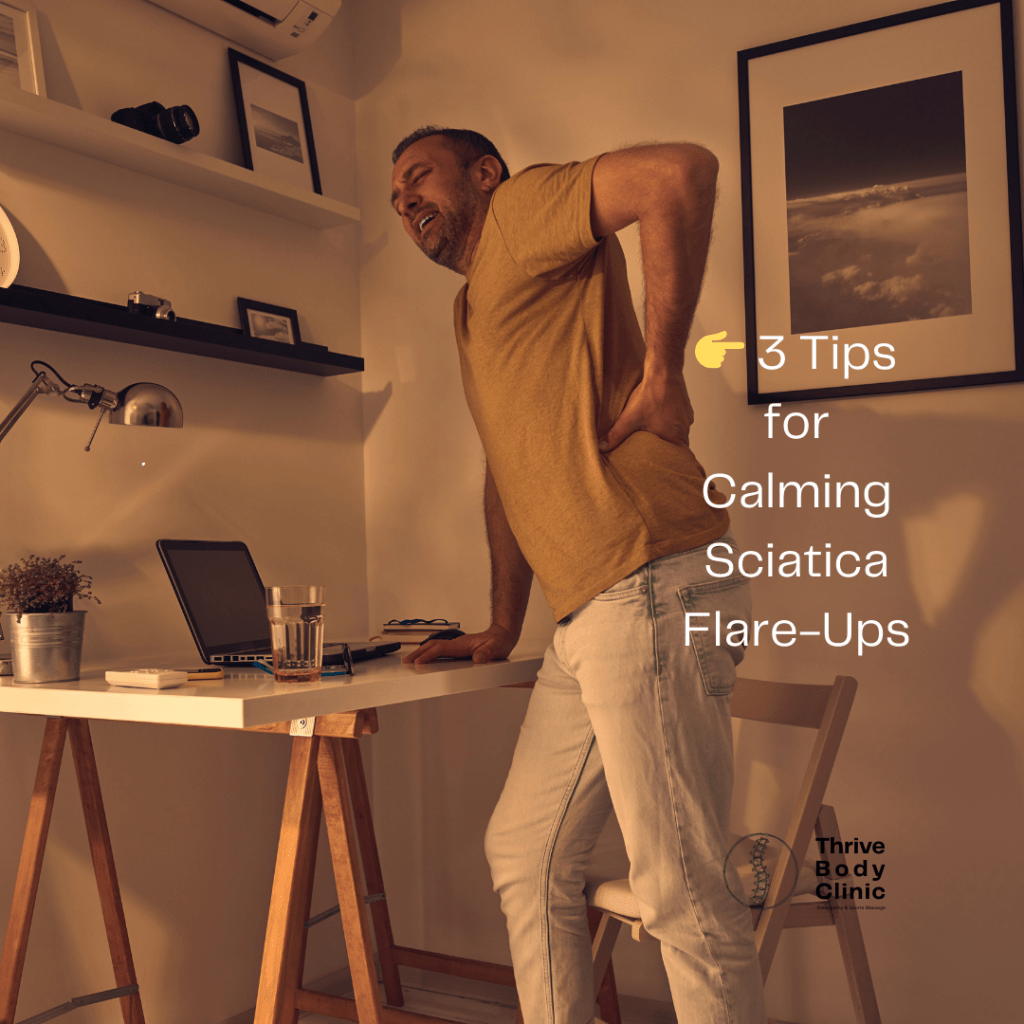
If you’ve ever had sciatica, you already know it’s not “just a bit of back pain.”
It’s that sharp, burning, electric, or dragging pain that can shoot from your lower back or bum down the leg. Sitting hurts. Standing hurts. Walking hurts. Sometimes even doing nothing hurts. It’s bloody uncomfortable and, understandably, it can be scary.
You start worrying:
“Have I trapped a nerve?”
“Am I damaging something every time it hurts?”
“Will this ever calm down?”
Let’s get one thing straight from the start:
- Sciatica is horrible.
- Sciatica is usually temporary.
- And you are not as fragile as your pain is making you feel.
At Thrive Body Clinic, I see a lot of people who are juggling work, kids, stress, and then sciatica lands on top like a final insult. The good news? There are things you can do to calm a flare-up and feel more in control.
Here are 3 practical tips to help you ride it out more safely and confidently.
Quick note: If you’ve got numbness around your saddle area, loss of bladder or bowel control, or sudden, severe weakness in the legs, that’s an emergency. Get checked at A&E straight away.
Tip 1: Find Positions of Ease (and Use Them on Purpose)
When sciatica kicks off, the instinct is often to either keep pushing through or collapse on the sofa and not move at all. Neither is ideal.
The first job is to find positions that genuinely ease things – not cure, but reduce the intensity – and then use them strategically.
A few options to experiment with:
- Hook-lying (feet up, knees bent)
Lie on your back with your knees bent and feet flat on the floor or sofa. You can rest your lower legs on a chair so hips and knees are at 90°. This often takes pressure off the lower back and leg. - Side-lying with a pillow
Lie on your side with a pillow between your knees. Try the painful side up and down and notice which one feels more settled. - Forward lean in sitting
Sitting on a chair, gently lean forward onto your thighs or a table. For some people, this eases the leg pulling.
The key is to notice what your body likes rather than chasing some magic posture off Google.
Once you’ve found 1–2 “positions of ease”, use them:
- At the end of the day
- When things start to spike
- Before bed as a calm-down practice
Think of them as “pressure relief” for your irritated system, not a prison you have to stay in.
Tip 2: Keep Moving – But Dial Down the Dose
Let’s bin the myth:
“If I move, I’ll make it worse – I should rest until it’s gone.”
No. Full stop.
Complete rest for days on end usually makes things more sensitive and stiff. But forcing yourself through high-intensity training or long walks when your leg feels like it’s on fire isn’t smart either.
The sweet spot is gentle, regular, low-dose movement.
A few ideas:
- Short, frequent walks
Instead of one big 30–40 minute walk, try multiple 3–5 minute walks spaced through the day. Stop before you hit your limit. - Pelvic tilts in lying
On your back with knees bent, gently rock your pelvis so your lower back flattens slightly into the floor, then relax. Slow and small. 10–15 reps. - Gentle knee hugs (if tolerated)
On your back, bring one knee towards your chest to a comfortable range, then lower. Not yanking. Just inviting movement.
You’re sending your nervous system the message:
“Yes, we’re irritated – but we’re safe enough to move.”
If walking 5 minutes spikes things to a 7/10, that’s too much right now. Try 2–3 minutes and see how your body responds.
Movement is medicine – but only at the right dose.
Tip 3: Pace Your Day Like Your Back and Nerve Actually Matter
One thing I see all the time:
People behave as if nothing’s wrong all day – dragging shopping, doing DIY, pushing through work – and then by early evening their sciatica is raging and they’re shocked.
A flare-up is your body asking for a bit of pacing, not a drama script.
Pacing doesn’t mean “doing nothing.” It means:
- Breaking tasks into shorter chunks
- Alternating between sitting, standing, and walking
- Planning one or two “bigger” tasks a day, not six
- Using your “positions of ease” from Tip 1 proactively, not just when you’re desperate
Example:
Instead of:
- Two hours non-stop cleaning → massive pain spike
Try:
- 20 minutes light housework → 5 minutes lying with legs up
- Repeat 2–3 times spread across the day
You’re still living your life. You’re just respecting the fact that an irritated sciatic nerve has a lower tolerance right now.
The aim is to stay just inside what your body can currently handle, so it has a chance to settle rather than stay on high alert.
Reassurance: Sciatica Is Loud – But Loud Doesn’t Mean Broken
Sciatica feels dramatic. It’s sharp, it’s electric, it can catch you off-guard. That often makes people think something catastrophic must be happening every time it twinges.
In reality, sciatica is often about an irritated nerve in a sensitised system. Loud, yes. Damaged forever, usually no.
With the right:
- Positions to offload
- Gentle movement
- Smarter pacing
…most people come out the other side. And then the work shifts to building strength, mobility and confidence so it’s less likely to come back.
That’s where good rehab – and yes, osteopathy – fits in.
If sciatica is making you nervous to move, keeping you up at night, or you’ve had multiple flare-ups and feel stuck, you don’t have to figure this out alone.
At Thrive Body Clinic, we’ll:
- Assess what’s actually going on
- Help calm the irritation
- Build a plan that fits your life, not someone else’s
You can book an appointment and we’ll work through it together.
 Thrive Body Clinic Osteopathy & Sports Massage
Leave a comment