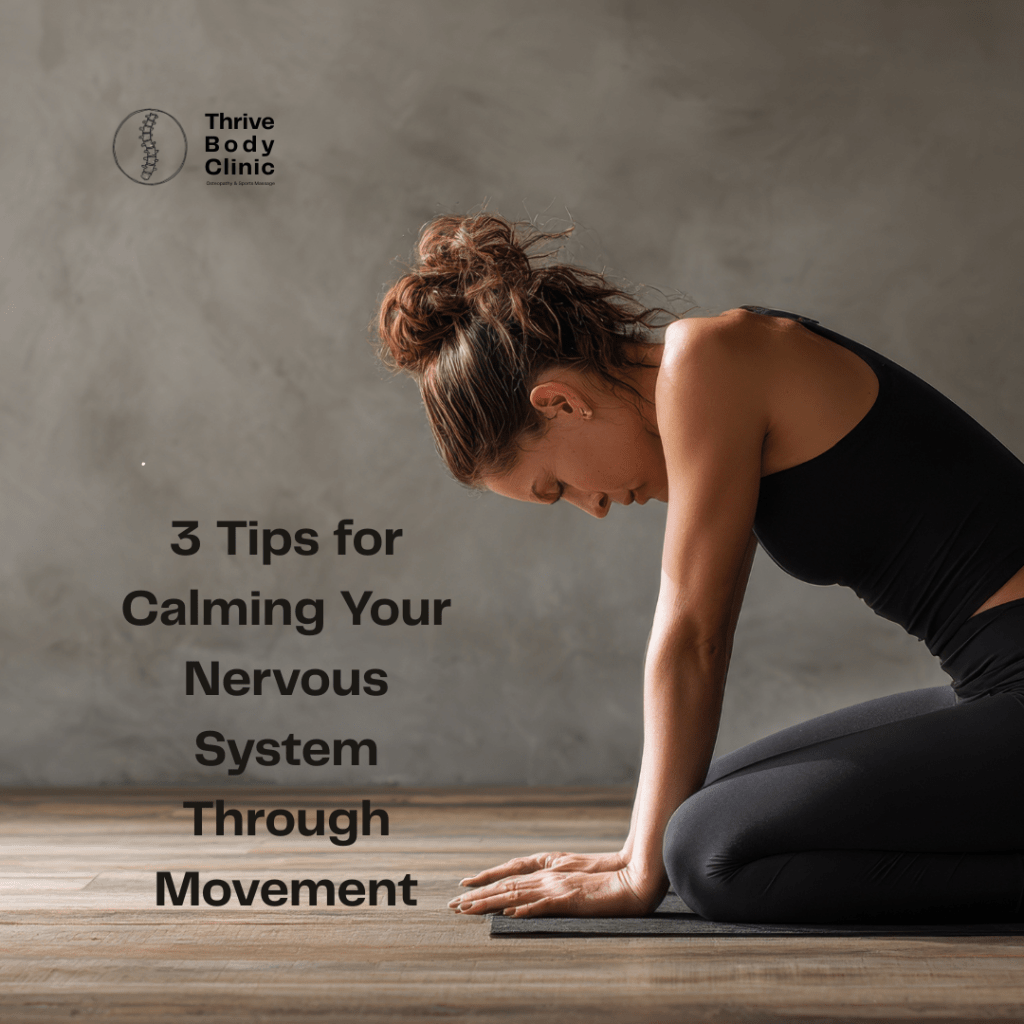
Let’s be honest: most mid-life adults are running on fumes. Work deadlines, family chaos, constant notifications, poor sleep… it all adds up. And before you know it, your body’s stuck in a low-level “fight or flight” mode.
You can feel it.
Your shoulders creep up.
Your breath gets shallow.
Your back feels tighter for no logical reason.
Your brain feels foggy, but your body feels wired.
This isn’t “you getting old.”
This is your nervous system waving a big flag saying, “Oi… slow down.”
One of the simplest, most effective ways to calm everything down?
Movement. Not workouts. Not yoga retreats. Just movement — done right.
At Thrive Body Clinic in Worthing, this is something I talk about constantly with patients. Calming your nervous system isn’t about being zen on a mountain. It’s about creating small moments in your day where your body feels safe, grounded, and less like it’s sprinting on the inside.
Here are 3 practical, no-BS ways to use movement to bring your nervous system back down to earth.
1. Move Slow… On Purpose (Your Nervous System Loves It)
When you’re stressed, your whole system speeds up — thoughts, breathing, muscle tension, the lot.
So one of the best ways to counteract that?
Do the opposite. Move slowly.
Slow, controlled movements send a “we’re safe” message to the brain.
Fast, jerky movements signal threat. Simple as that.
Try this:
- Sit or stand tall
- Roll your shoulders in a slow circle (10 seconds per circle)
- Don’t rush the awkward bits — lean into them
- Breathe gently while you do it
Feels almost stupidly simple, but it works because you’re giving your nervous system a clear signal to downshift.
This applies to everything:
- Slow neck movements
- Slow side bends
- Slow hip circles
- Slow reaching motions
You don’t need a mat, Lycra, or 20 spare minutes.
You just need intentional slowness — it’s the antidote to being mentally fried.
2. Breathe Like You Actually Mean It
I’m not talking about meditation apps or forcing yourself to “be calm.”
I mean physically using your breath to control your physiology.
When you breathe shallow and high into your chest, your body assumes something’s wrong.
When you breathe slow and low, into your ribcage and belly, your body relaxes. It’s hard-wired.
Try the “4–6 breath”:
- Breathe in for 4 seconds
- Breathe out for 6 seconds
- Repeat 6–10 times
The longer out-breath switches on your parasympathetic nervous system — the calming side of things.
Why pair this with movement?
Because the combo is powerful.
Movement loosens tension.
Breath lowers the internal “alarm.”
Together, they create almost instant relief for people carrying stress in their neck, back, shoulders, or jaw (so… most of you).
3. Bring Your Awareness Back Into Your Body
When you’re stressed, you stop listening to your body.
You get stuck in your head, rushing around, ignoring early warning signs until something finally hurts enough for you to notice.
Body awareness — or “interoception” if we’re being fancy — is your ability to feel what your body needs before it shouts at you.
Try this 2-minute drill:
- Stand or sit comfortably
- Close your eyes
- Notice your feet on the floor
- Notice your breath moving your ribs
- Notice where you’re tense
- Relax one area at a time
No woo-woo. No spiritual journey.
Just checking in.
Then add gentle movement:
- If your ribs feel tight → stretch side to side
- If your shoulders feel heavy → do slow circles
- If your low back feels stuck → gentle hip tilts
This is how you interrupt the stress loop before it spirals into headaches, back pain, or that “I feel 90 when I stand up” stiffness.
Putting It All Together (A 3-Minute Reset)
Here’s a quick routine you can do anytime your brain feels frazzled or your body feels tight:
1. 6 slow shoulder rolls (10 seconds per roll)
2. 10 slow breaths (4 in, 6 out)
3. 1 minute of gentle spinal movement — twists, bends, whatever feels good
4. 30 seconds noticing what feels easier
Patients are shocked at how quickly this makes them feel more present, calmer, and physically looser.
It’s not magic — it’s basic physiology.
And it works every single time.
Final Thoughts
You don’t need massages every week.
You don’t need an hour-long yoga class.
You don’t need to “calm down” (which never works anyway).
What you do need is a way to tell your nervous system:
“We’re alright. You can chill.”
Movement, awareness, and breath give you that power — daily.
And if you want support with the aches, tightness, or stress patterns that won’t shift, you know where I am.
 Thrive Body Clinic Osteopathy & Sports Massage
Leave a comment