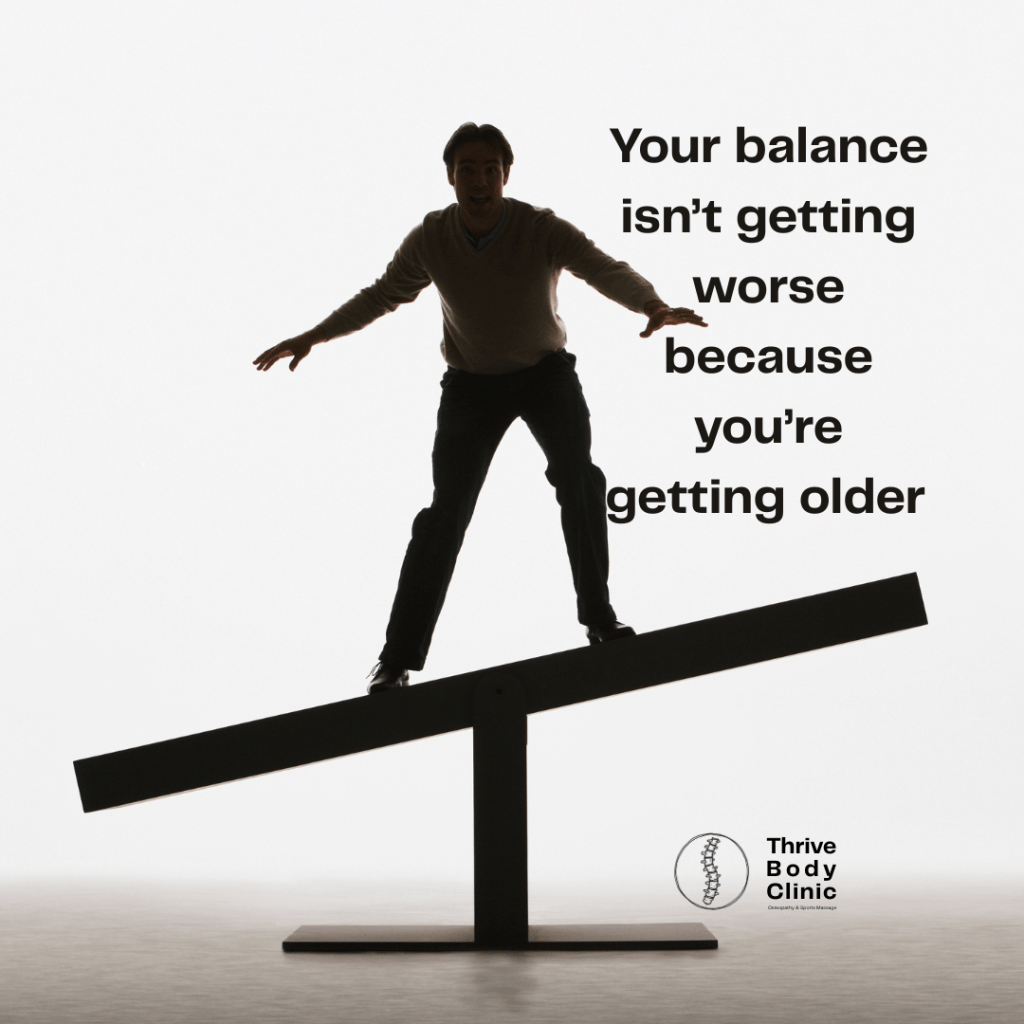
Let’s be honest — losing your balance is one of those things that sneaks up on you.
One minute you’re hopping over a puddle without thinking, and the next you’re grabbing the banister like you’re 96, not mid-40s. It’s frustrating, a bit of a wake-up call, and for a lot of people, quietly embarrassing.
But here’s the good news: balance isn’t reserved for athletes, yoga instructors, or those people who somehow have time to stretch before work. Balance is a skill — and skills can be trained. And the sooner you start, the easier it stays.
Most of the patients I see at Thrive Body Clinic in Worthing don’t have a “balance problem” — they have a foot weakness problem, a stiff joint problem, or a not-moving-enough-during-the-day problem. All fixable. None require gadgets, wobble boards, or a gym membership you won’t use.
Here are three practical tips you can start today.
Tip 1: Strengthen Your Feet — Your Balance Starts at Ground Level
Your feet do more than stop you walking around barefoot like a teenager.
They’re packed with muscles, receptors, and joints that tell your brain where you are in space. The stronger and more awake your feet are, the better your balance becomes. Simple as that.
Here’s the mistake most people make:
They jump straight to fancy balance drills without fixing the foundations.
Trying to improve balance without foot strength is like trying to build a conservatory on jelly.
Start with this:
- Toe spreads — Sit or stand. Spread your toes out like you’re trying to make hand signals with your feet. Hold 5 seconds. Repeat 10 times each foot.
- Short foot exercise — Gently pull the base of your big toe toward your heel without curling your toes. You’ll feel the arch activate.
- Barefoot time — Start with 2–5 mins at home. Let your feet actually feel the floor. Don’t overthink it.
Small, boring, unsexy exercises — but they work. And they massively improve joint stability up the chain (knees, hips, back).
Your feet are the foundation of your balance. Start waking them up today.
Tip 2: Train Your Awareness — Your Brain Uses Movement as Data
Balance isn’t only about muscle. It’s about how fast your brain processes information. If your eyes, inner ear, and joint sensors aren’t communicating well, your balance feels off — even if you’re strong.
And here’s the kicker: the less you challenge your balance, the worse your awareness gets.
This is why desk workers often notice they feel more wobbly stepping off a curb, climbing stairs carrying bags, or walking on uneven ground. Their brain simply isn’t getting enough movement-based feedback during the day.
Try this today (takes 30 seconds):
- Stand on one leg while brushing your teeth.
- Switch legs halfway through.
- Do it every day.
It’s simple. It’s mildly annoying. And it works.
You’re training your brain to pay attention again.
Better awareness = fewer stumbles, better confidence, and less tension in your body.
Tip 3: Keep Your Ankles and Hips Moving — Stiff Joints Kill Balance
When someone tells me they’ve “suddenly” lost their balance, what they usually mean is:
“I haven’t moved enough in the past 10–20 years, and now my joints are telling me off.”
Stiff ankles mean you can’t adjust quickly.
Stiff hips mean your pelvis can’t stabilise properly.
Together, they make simple movements feel unpredictable and sometimes downright dodgy.
But you don’t need a full mobility routine. You just need consistency.
Two key joints to unlock daily:
Ankles
- Circles (big, slow, controlled) — 10 each way
- Calf raises — 10–15 reps
- Leaning ankle mobility against the wall — 10 reps
Hips
- Gentle hip circles
- Slow controlled marching (standing)
- Step-ups on stairs
- Lunges if your knees allow it
You’re teaching your joints to move smoothly.
Smooth movement = confident balance.
If you only pick one thing from this entire blog, pick this:
Move your hips and ankles every day. Your future self will genuinely thank you.
Balance Is a Lifetime Skill — Protect It Now
Getting older doesn’t mean getting unsteady.
Losing balance is not “inevitable” or “just age.”
It’s usually a sign you’ve stopped challenging your body in the small, daily ways it needs.
By strengthening your feet, improving your awareness, and keeping your joints moving, you build balance that lasts decades.
If your balance already feels off — or you’re noticing tension, stiffness, or a decrease in confidence when walking — don’t ignore it. That’s your body giving you a nudge.
Sometimes, a professional assessment and a tailored plan make all the difference.
If you want help improving your balance, reducing stiffness, or feeling more confident on your feet, book an appointment at Thrive Body Clinic, Worthing.
Let’s get you moving well — and staying steady — for the long haul.
 Thrive Body Clinic Osteopathy & Sports Massage
Leave a comment