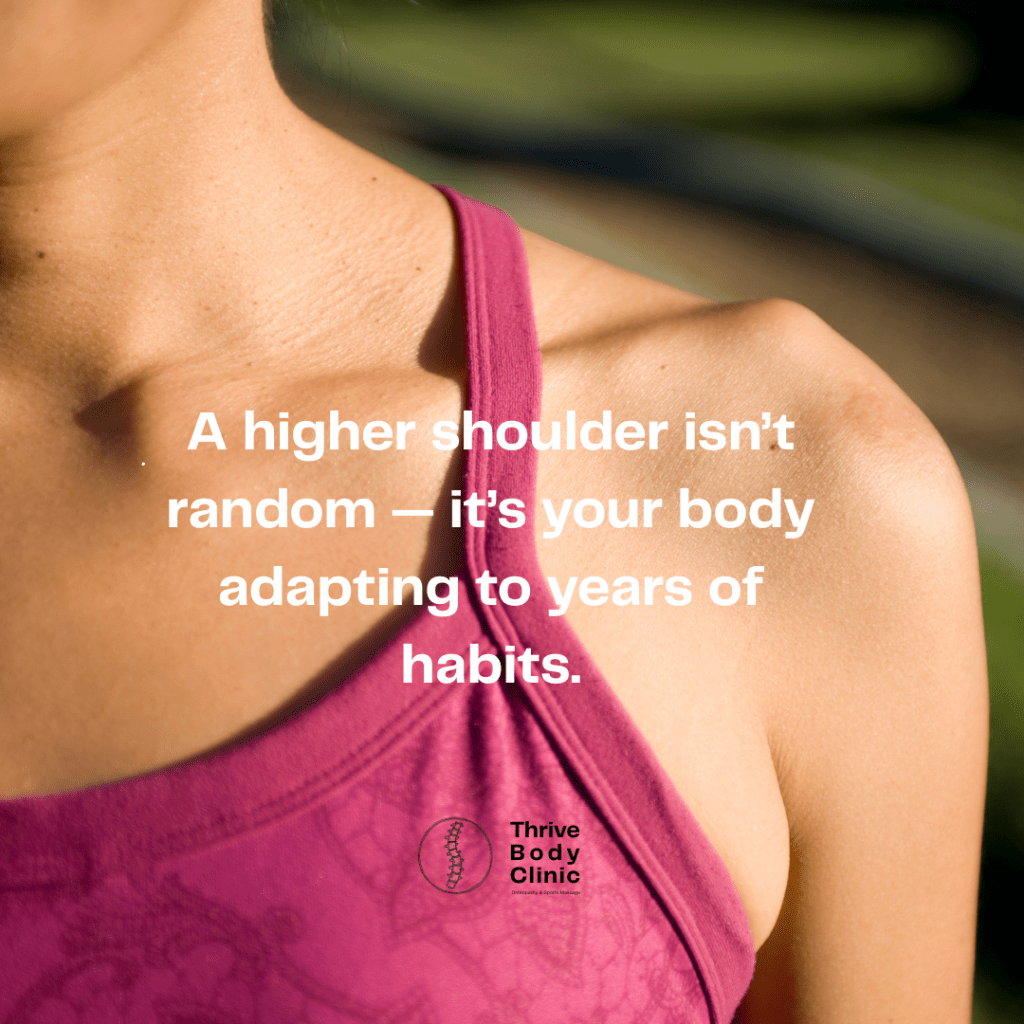
Ever looked in the mirror and thought, “Why does one shoulder sit higher than the other?”
You’re not imagining it.
And no, it’s not because you “slept funny” or “carry your bag on one side.”
A tilted shoulder can be your body’s way of saying it’s been adapting — for a long time.
At Thrive Body Clinic, we see this all the time. Someone books in with neck stiffness, shoulder tightness, or that constant upper back ache that never quite shifts — and when they stand up straight, one shoulder’s clearly higher. Let’s unpack what’s really going on.
🧍♂️ Posture Isn’t Static — It’s a Story
Think of your posture like your handwriting — unique to you, shaped by everything you’ve done and everything your body’s been through.
Your body constantly adapts to what you do most.
If you sit leaning on one elbow, carry a child on one hip, or spend 8 hours hunched over a laptop — your muscles, joints, and fascia mould around those patterns.
Over time, these “micro-habits” can shift how your shoulders sit, how your spine stacks, and how your ribs move when you breathe.
One shoulder higher? It’s rarely a single cause. It’s the result of your body’s brilliant ability to compensate.
⚙️ Common Causes Behind an Uneven Shoulder
Here are some of the big culprits we see in clinic:
- Dominant-side overload — Right-handed? You probably reach, lift, and twist that side thousands more times a week. The shoulder blade muscles adapt, pulling one side tighter.
- Tight neck or upper back fascia — When the tissue across your neck or upper ribs becomes less elastic, it can literally ‘tether’ one shoulder upwards.
- Pelvic tilt or spinal curve — The shoulder rarely acts alone. If your pelvis sits slightly rotated or your spine curves from old habits or injuries, your upper body adjusts to level your eyes with the horizon.
- Breathing pattern shifts — Shallow, chest-based breathing can stiffen the upper ribs and lift one shoulder subtly over time.
- Old injuries — Sprains, surgeries, or protective patterns can lock one side into tension that lingers long after the pain fades.
💥 The Knock-On Effects
A higher shoulder doesn’t just “look off” — it feels off.
It can lead to:
- Neck tension or headaches on one side
- Shoulder impingement or rotator cuff pain
- Rib and upper back stiffness
- Limited reach or movement
- Even jaw discomfort or imbalance
You might not notice pain directly where the imbalance is — it often shows up one or two steps away.
👐 How Osteopathy Helps
Osteopathy doesn’t chase symptoms. We look for why your shoulder’s sitting higher and what else is being pulled along with it.
During treatment, we’ll:
- Assess your spine, ribs, and pelvis together (because they move as one system).
- Release tight fascia or joint restrictions that are pulling the shoulder up.
- Improve rib and spinal movement so the shoulders can naturally level.
- Guide you through targeted movement or breathing work to retrain your posture from the inside out.
This isn’t about “standing up straight.” It’s about restoring balance and ease so your posture takes care of itself again.
💪 What You Can Do at Home
Between treatments, you can make a big difference yourself:
- Move more, sit less — Change positions regularly, even for a minute or two.
- Breathe deeper — Practice slow, wide ribcage breathing instead of shallow chest lifts.
- Switch sides — Alternate which side you carry bags, children, or phones.
- Strengthen symmetry — Train both sides equally; don’t always lead with your dominant hand.
Small, consistent changes help reset long-held postural habits over time.
🌿 The Bottom Line
A higher shoulder isn’t something to panic about — but it is something to pay attention to.
Your body’s telling you it’s been compensating. With the right treatment, movement, and awareness, that imbalance can change.
If you’ve noticed uneven shoulders, tension, or that persistent upper back tightness — let’s sort it.
👉 Book your appointment at Thrive Body Clinic today and let’s get your body balanced again.
 Thrive Body Clinic Osteopathy & Sports Massage
Leave a comment