The Overlooked Culprit
If you’ve ever had nagging shoulder pain or a stiff upper back that just won’t shift — even after stretching, massaging, or clicking everything in sight — you might be missing a key piece of the puzzle: your ribcage.
We tend to think of ribs as just the bony armour protecting our lungs and heart. But they’re actually a major part of your movement system. Every breath you take moves them. Every twist, reach, or arm lift depends on them.
So when your ribs stop moving well, it’s like having a kink in the gears of your body — everything above and below starts to work overtime.
How the Ribcage Influences Your Back and Shoulders
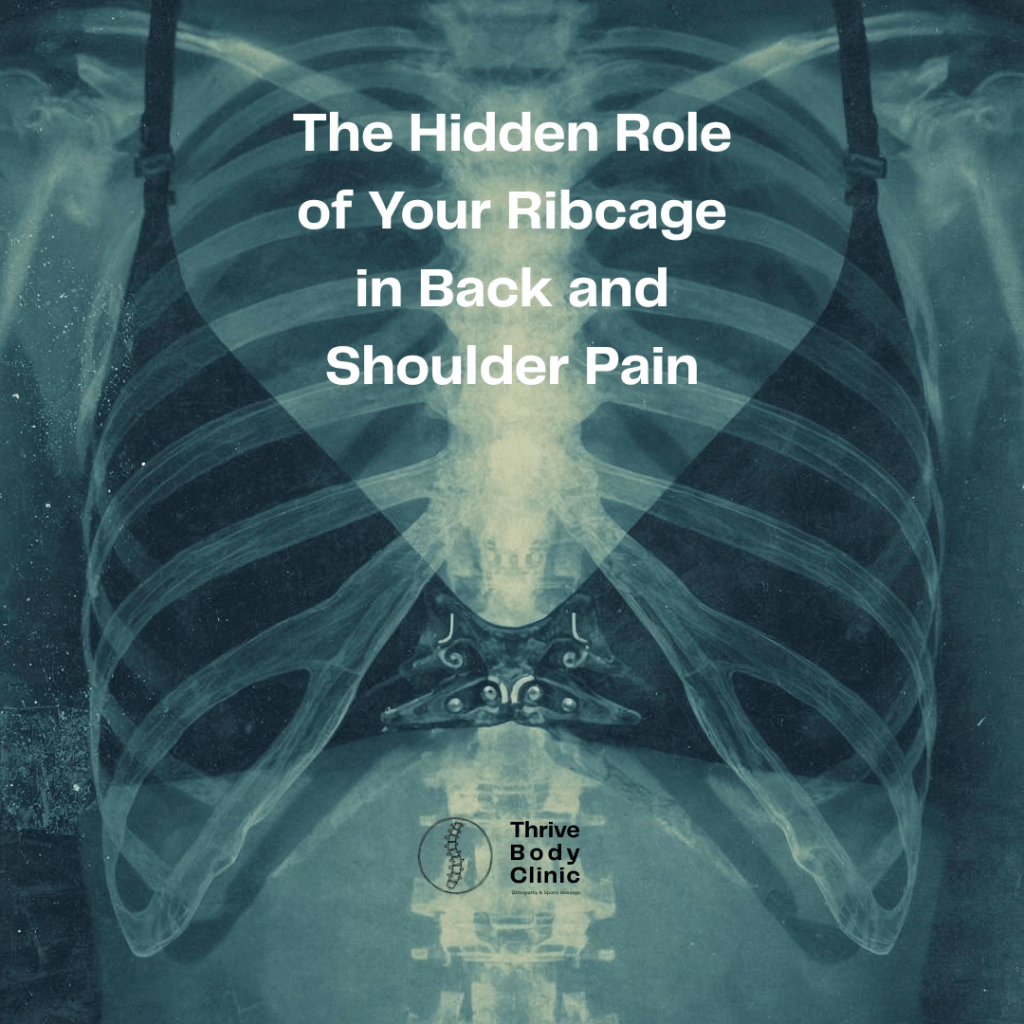
Your ribcage is made up of 12 pairs of ribs, all connected through joints, muscles, and fascia to your spine and breastbone. That means it’s deeply linked to both your upper back (thoracic spine) and your shoulders.
Here’s the bit most people don’t realise:
Your shoulder blade rides on your ribcage. It doesn’t attach to it like a hinge — it glides over it. That means if your ribs are stiff, rotated, or slightly “locked,” your shoulder blade can’t move smoothly. The result? Shoulder pain, pinching, or that annoying “tight spot” between your shoulder blades.
Your ribs also move with every breath. When that motion gets shallow or restricted — maybe because of poor posture, long hours at a desk, stress, or past injuries — your spine has to compensate. That often shows up as mid-back stiffness or even neck tension.
👉 Think of your ribcage like a flexible spring. When it’s free, movement flows. When it’s stuck, pressure builds up somewhere else.
Common Reasons the Ribcage Gets “Stuck”
- Postural overload: Hours hunched over screens compress the rib joints and reduce mobility.
- Stress and breathing habits: Shallow breathing keeps the ribs barely moving, especially in the lower half.
- Old injuries: A fall, car accident, or even a bad cough can subtly alter how ribs move for years.
- Weak or overactive muscles: If certain muscles around your chest or shoulder girdle dominate, they can literally pull the ribs out of sync.
You might not even feel it in your ribs — it often shows up as shoulder impingement, rotator cuff irritation, or upper back ache that flares when you sit too long.
How Osteopathy Helps
Osteopathic treatment looks beyond where it hurts to why it hurts. If your shoulder is sore, we’ll look at how your ribs, spine, and breathing are working together.
Treatment usually involves:
- Gentle hands-on techniques to restore rib and spinal mobility
- Soft tissue release around the shoulder and chest
- Guided breathing to reconnect rib movement and diaphragm control
- Movement coaching so you build strength through proper range
When we free up the ribcage, it’s like hitting “reset” on your posture. Shoulders sit more naturally, breathing feels easier, and tension drops.
What You Can Do at Home
You don’t need to buy special gear or do fancy routines — just focus on reconnecting to your breath and movement.
Here are two simple things you can try:
- Side breathing drill:
- Lie on your back or side.
- Place one hand on the side of your ribs.
- Inhale slowly through your nose, feeling your ribs expand sideways.
- Exhale through your mouth, letting them fall gently.
- Repeat for 2–3 minutes.
- Open book stretch:
- Lie on your side with knees bent.
- Reach your top arm across your chest and slowly open it out until you’re looking up to the ceiling.
- Feel the ribs rotate and open.
- 6–8 reps each side.
Small, consistent mobility work can make a big difference when your ribs are the missing link.
The Takeaway
Your ribcage isn’t just a cage — it’s a dynamic, breathing, moving structure that connects your spine, shoulders, and posture. When it’s stiff, the whole system suffers.
At Thrive Body Clinic, we help you understand and feel how these parts connect, so you can move freely, breathe easier, and stop chasing pain from one spot to another.
 Thrive Body Clinic Osteopathy & Sports Massage
Leave a comment